Thursday, November 10, 2016

Media Fail

I was listening this mourning to PBS News Hour as it discussed the 2016 election. Part of that discussion addressed media failings. The consensus was that the media didn't do a good job of examining the disaffection that lead to Mr Trump's election. In that regard I offer the following observations.

  1. First, it's true. The main stream media did not understand or cover just how disaffected much of the country is with politics. For some time I have believed that Mr Sanders and Mr Trump are two sides of the common disaffection that the majority of citizens feel with government. Mr Trump harvested that disaffection with telling us who to blame. Mr Sanders addressed it with real proposals for what to do. It seems that it is far easier for most of us to decide who to blame than to actually engage real problems with real solutions. While entirely understandable, even predictable, it is a sad commentary of the state of America.
  2. Second, while true, that failure is entirely irrelevant. The real important failures are entirely elsewhere. The media, political parties, and common thinking continue to promote the absurd notion that the President some how runs the country. That notion is not simply untrue in that it distracts us from the way government really works! Congress, not the President, is responsible for making laws! It's just that simple. If you want good government, if you want a real problem addressed, then it is Congress and law that matters far more than the President. Want to get big money out of politics? That requires Congress to act. Want to do something about skyrocketing medical cost? That requires Congress to act. Want to do something about global warming? It's Congress! Most of us do not understand this simple civics truth. To paraphrase that old saw, IT'S CONGRESS STUPID! The media has failed because it treated an election where all of the House and much of the Senate was up for reelection as though it was a contest between two people representing a red team and a blue team. It simply wasn't! 
One might argue that is is not the media's responsibility to educate us on how government works. While there is certainly some truth in that argument it fails to recognize that in a free society the media is not just responsible for reporting what happens, it is also responsible for helping us understand why it matters.

 So here's a thought; take a minute and read a bit about how Congress actually works. Here are some useful references:

Tuesday, August 23, 2016

Trumpmouth Time Constant

Mr Trump has been in the news lately for using a teleprompter for some of his speeches. For the moment lets put aside the fact that it is newsworthy when a presidential candidate uses a teleprompter to deliver a coherent, though factually incorrect, speech.

Having delivered one teleprompter speech, the next day 'trumpmouth' strikes and Mr Trump manages to make another outrageous statement.  Various RNC pundits bemoan this state of affairs and encourage Mr Trump to get and stay on message.  OK, lets put aside that fact that staying on message is not the same as what a would be president actually believes, how he actually acts, or how he might actually govern.  Staying on message is better than not.

A couple of days later Mr Trump actually manages to give a couple of back to back teleprompter speeches before once again getting a case of 'trumpmouth'.  The cycle repeats.  A few days later Mr Trump manages three consecutive teleprompter speeches before once again 'trumpmouth' strikes.

In what alternate reality is apparently incurable 'trumpmouth' a good thing in a president?


Wednesday, July 20, 2016

Trump and alternate reality

So on the news last night a 'millennial' Trump supporter picks up red 'Make America Great Again' had and puts it on then explains that he supports Trump because Trump will bring back manufacturing jobs to America.

Just one small issue - the had was made in China! Clearly reality need not intrude when supporting Trump.

Tuesday, March 1, 2016

Vote for the other guy, even if you think that's worse

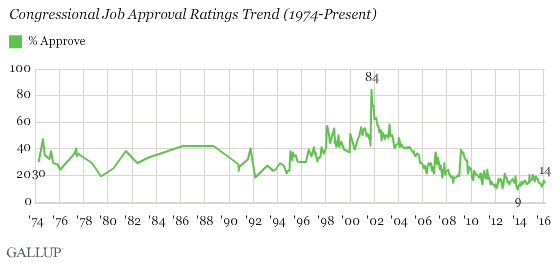
Congress's approval rate is somewhere around 14%.  It has been falling steadily for many years. Here's the data from Gallup.


A total of 469 seats in the U.S. Congress (34 Senate seats and all 435 House seats) are up for election on November 8, 2016. That's 88%.

Reelection rates are generally around 90%.  Here's the data from Open Secrets.


So here's the thing, 
  • we actually do have a choice, and
  • we do not need to vote for the guy that doesn't represent us.
Don't get me wrong.  The other guy can be, and sadly often is, worse.  But if we keep firing politicians that do not represent us sooner or later we'll get some that do.

It's a bit of a radical notion I know but, hey, the other way just hasn't worked.  Perhaps it's worth considering.

Just a thought.

Monday, February 29, 2016

Cell phone privacy

By way of full disclosure:
  • I own a smart phone
  • I store some data on the phone
  • I do not store highly sensitive data on the phone
  • The phone unlock is secured by fingerprint and long relatively secure password
  • The data on the phone is encrypted
  • I am a very senior technologist very familiar with the related technologies.
Now lets consider privacy.

If my phone is lost or stolen do I need my data secured? Not really, but then I do not store highly sensitive data on the phone.

In my particular case there is some inconvenience and marginal risk but it is really rather minimal.

It is significant that I'm a technologies and know technology actually works and have considerable experience with the way technology companies really behave.  I have made an informed decision that neither the technology or the companies that provide it may be trusted to keep sensitive data secure. That being the case I rationally choose to limit my exposure.  Others might want to think about that as well.

So am I willing to unlock my phone and have my data exposed if the phone is lost or stolen?  No. My concerns are twofold.

First, I believe in personal privacy generally.  I believe that each of us should get to decide for ourselves what to share, when to share, and who to share with.  If I take a photo at a family gathering, there is really no harm in the entire world seeing it, but that doesn't make it the business of the whole world.  If I do not choose to share no one else should have a right to see it.  It is a matter of principal. So if by some mischance I loose possession of my phone I do not want others to have access to data on the phone.

Second, knowing the way phones and billing actually work, I really, really, really do not want someone else to be able to use my phone to create bills attributable to me.  It is actually this matter that I am most concerned about, not the actual data on the phone.

What about people who actually store sensitive data on their phone?  I believe that such people are stunningly naive.  But, I acknowledge that cell phones are remarkably useful, more or less ubiquitous, and many people think it is OK to store sensitive data on their cell phone.

Should the data of people who actually store sensitive data on their phone be protected?  Yes. As a society we frequently require that we be protected from our own mistakes and bad decisions.  So while storing sensitive data on your phone is, in my view, a bad decision, I do think it should be protected.

Should that protection be absolute?  No.  Privacy rights in the US derive largely from the Fourth Amendment.  That protection immunizes data from search unless there is a valid warrant.

This is one of the central issues at the core of the current Apple v. FBI controversy.  Notwithstanding all that has been said or written there is simply no absolute right to privacy in law. Indeed, claims that cell phone data should have an absolute privacy right are novel and unprecedented in that no other data storage mechanism or device, save a corporal human, possesses such rights.

Much that has been said or written effectively asserts just such a right but it does not exist, nor, in my view should it.  The Fourth Amendment expresses two essentials of privacy.  The first principal is that by default our person and writings, and by extension our data, is private and not subject to government scrutiny.  The second is that notwithstanding the first principal there are circumstance where there is a legitimate government interest that overrides the first principal.  That is what a warrant is.

Should an exemption to warrant search be created for cell phones? No.

While there are exceptions to warrant search, such exceptions are rooted in profound social relationships such as marriage or religion. While many may have a strong personal attachment to their cell phones there is simply no underlying social relationship.

It is important to realize that cell phones that store data are simply small computing devices able to connect to various networks for various purposes including making actual phone calls. The principal distinguishing characteristic from other computers is their size.  Indeed, everything I can so on my cell phone, I can do on my laptop or on my desktop even though I can not put either of these in my pocket.

Other computing devices do not have warrant exceptions.  Indeed, such devices are routinely subject to search under court order.

Common sense

  • Cell phones should support privacy
  • It should not be immune to warrant search

Sunday, February 28, 2016

Apple v FBI: What does the judge's order actually say

The specifics of this order are very important and have been widely distorted and misrepresented. This post attempts to state the essential elements of the order in a simple non-technical manner so that others may better understand the issues.

The order itself can be found here. There was some subsequent alteration of the original order (link needed).  In summary it requires the following:
  • the creation of software that bypasses the delay and destruction features associated with unlocking the phone
  • keying the software to this specific phone
  • provide mechanisms that allow the FBI to access the phone to conduct a brute-force unlock
The order further provides:
  • The phone may be in Apple's possession during the unlock process and work performed at an Apple facility
  • Apple need not provide the software in any form to the FBI
  • Apple is free to dispose of the software as it wishes
  • Apple is compensated for their work supporting the FBI
Note: if this summary of the order is in any way factually incorrect or biased please let me know.